UK Customer Services Mon-Fri 9-5


Buying Guide
Create the perfect outdoor cooking space
The best outdoor kitchens aren’t designed around cooking. They’re designed around not having to leave.

There’s a particular kind of host who disappears at their own parties. The kitchen is in one place, and the guests are in another, and for a couple of hours someone is shuttling between them, slightly frantic, pretending they’re fine. The food arrives. The cook arrives ten minutes later, a little undone.
An outdoor kitchen, done properly, ends that dynamic. Not just because it moves the cooking outside, but because it changes the relationship between the person cooking and the people they’re cooking for. Get the configuration right, and you’re at the grill, yes, but you’re also in the conversation. That’s the problem worth solving.
This is what the Savannah system was built around.
The best outdoor kitchens aren’t designed around cooking. They’re designed around not having to leave.
Start with the layout, not the product
The most common mistake in outdoor kitchen design is buying units before you’ve decided how you actually want to use them. The kitchens that work beautifully are the ones where prep, cooking and serving happen in a natural sequence, not in three different corners of the garden.
The Savannah range is modular because gardens aren’t standard. An urban terrace and a country patio don’t share the same footprint, shape or social habits. What they do share is the same need: a kitchen that works the way a kitchen should, just outdoors. Start with the core unit and build out to create an L-shape or U-shape that keeps everything within easy reach.

The starting point
The Savannah Hybrid 4-Burner in Oak effect at £1,399 gives you the precision of gas cooking in a frame that looks like it belongs in a well-considered indoor kitchen. It doesn’t behave like outdoor furniture. It behaves like a kitchen.
For higher-volume cooking
If your guest list regularly runs past eight, the Savannah Hybrid 6-Burner in Birch at £2,549 is the natural choice. The extra burner capacity changes what’s possible: multiple dishes, multiple temperatures, far less juggling.
The piece most people overlook
Corner units and storage cabinets, from £329, are rarely the glamorous part of an outdoor kitchen – but a lack of prep space is usually what breaks it. Add them and your L-shape becomes a proper working system. Skip them, and you’ll find yourself balancing serving dishes on a spare chair.
The sightline principle
Where you stand matters. Configure your units so that when you’re at the grill, you’re facing your guests rather than a fence or a blank wall. It sounds obvious, but most outdoor kitchens still get it wrong. The right sightline means you’re part of the party, not just catering for it.
What “built to last” really means
The warm, tactile quality of a wood-effect finish is worth having. It’s the difference between an outdoor kitchen that feels like a considered extension of the house and one that looks like a utility block that just ended up in the garden. It’s no surprise that it’s the finish most people reach for.
But the finish is only half the story. Underneath, the Savannah range is built on a powder-coated aluminium frame – a decision driven entirely by the realities of the British climate. Aluminium doesn’t rust. It doesn’t warp and twist through freeze–thaw cycles in the way timber frames can over their first few winters. It doesn’t ask for re-sealing, re-oiling or the annual maintenance rituals that turn a beautiful outdoor kitchen into a chore.
The oak effect brings warmth. The aluminium beneath it is what keeps it looking that way in ten years’ time.
The question to ask before you buy
Most outdoor kitchens look good on day one. The question to ask is not, “Does it look good?” It’s “What does the frame do in a hard frost? What happens after three wet springs?” The honest answers to those questions are where the real differences between products live – and they’re rarely the headline on a product page.
A kitchen needs a roof
An outdoor kitchen that comes to life in August but shuts down by October isn’t really a kitchen; it’s seasonal furniture. The difference between a space you use for two months and one you use all year usually comes down to shelter.
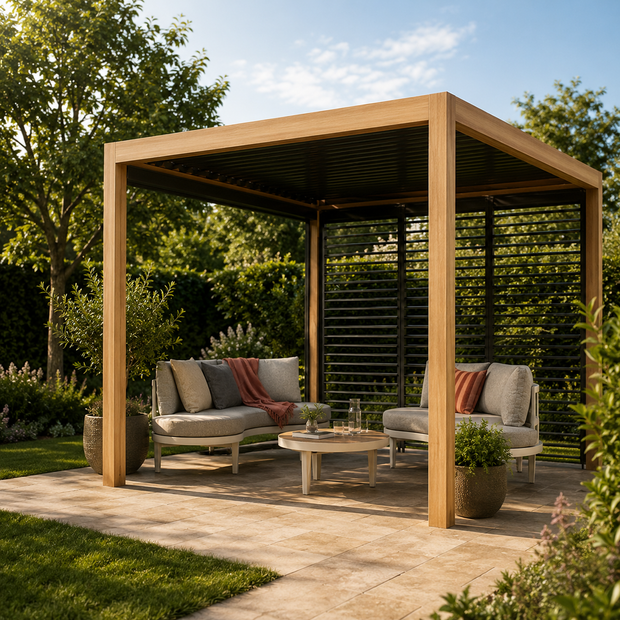
A Savannah BBQ Pergola, from £1,599, turns a run of units into a room. Motorised louvres mean you can dial light and shade up or down rather than choosing one or the other. Integrated LED lighting means dinner doesn’t end at dusk. Optional side walls take the edge off a cold May evening or a blustery September Sunday, so the default doesn’t have to be “let’s just go inside”.
Positioning a bar table and stools at the edge of the kitchen does something very specific to the atmosphere. It gives guests a place to be close to the action without getting in the way of it – the same counter-stool logic as a good open-plan kitchen, just moved outdoors. People naturally gather there. Conversations happen there. The host stops being the person who keeps disappearing and becomes the centre of things again.
After the meal: the layers that keep people there
The plates may be cleared, but the evening doesn’t have to end. A well-designed outdoor kitchen sets the stage for guests to linger not out of politeness, but because the space rewards staying.
Light at the right level
Harsh overhead light has a way of ending an evening. Softer, layered light extends it. Think solar lanterns, LED strips tucked into the pergola frame or low candlelight around the seating area. Let the kitchen’s integrated lighting take care of the practical jobs; let the rest of the lighting do the atmospheric work so the garden still feels like yours, just at a slower tempo.
Fire as a focal point
Fire pulls people in. It slows everything down, softens the conversation and makes sitting still feel intentional. A low-profile fire pit or gas chiminea near the dining area does more than add warmth; it gives the evening a focal point once the food has been cleared away. It taps into one of the oldest hosting instincts we have, and it works just as well in a small suburban garden as it does anywhere.
The goal was never simply to cook outside. It was to stop choosing between being a good cook and being a good host.


